In recent years, a visible paradigm shift has been taking place in the fields of home decoration trends and interior layout design. The classic layout scheme — ‘a large coffee table positioned at the center of the living room and a television aligned opposite it’ — is being replaced by more flexible and user-oriented planning approaches. The key behind this shift is changing lifestyles…
The answer to the question “How are we changing?” is clear: the widespread adoption of remote working models, the increase in small-square-meter urban apartments, the diversification of individual living practices, and the experience of multiple scenarios within the home in a single day are rendering spaces designed for a single function obsolete. In other words, the home is no longer a fixed composition; it is transforming into an organism that can evolve throughout the day and personalize itself under any condition.
We no longer see homes as frozen compositions. We do not anchor the home to a single alignment, a single focal point, or a single behavioral pattern.
Because with the 2020s, the home has become the interior reflection of a life in motion… Moreover, we now lead more dynamic and fluid lives — and those lives do not favor rigid arrangements or immovable plans.
So, WhaT Is ChaNgIng IN NeW LIvINg Spaces?
First of all, the mindset around ownership is shifting, and we are moving toward an understanding where the bond with space is defined not by possession, but by the ability to transform it. This is a system-based approach in which the user can move freely within the home, reorganize seating arrangements, and reposition objects according to evolving needs.
The key term here is modular furniture systems. Let’s explain this with an example: As mentioned earlier, in traditional living room planning, seating groups are generally aligned toward the television or a central coffee table. This setup fixes the space around a single focal point. However, today the living room serves as a workspace, social area, relaxation zone, and sometimes even a private retreat. A single-centered layout falls short in accommodating these multiple scenarios.
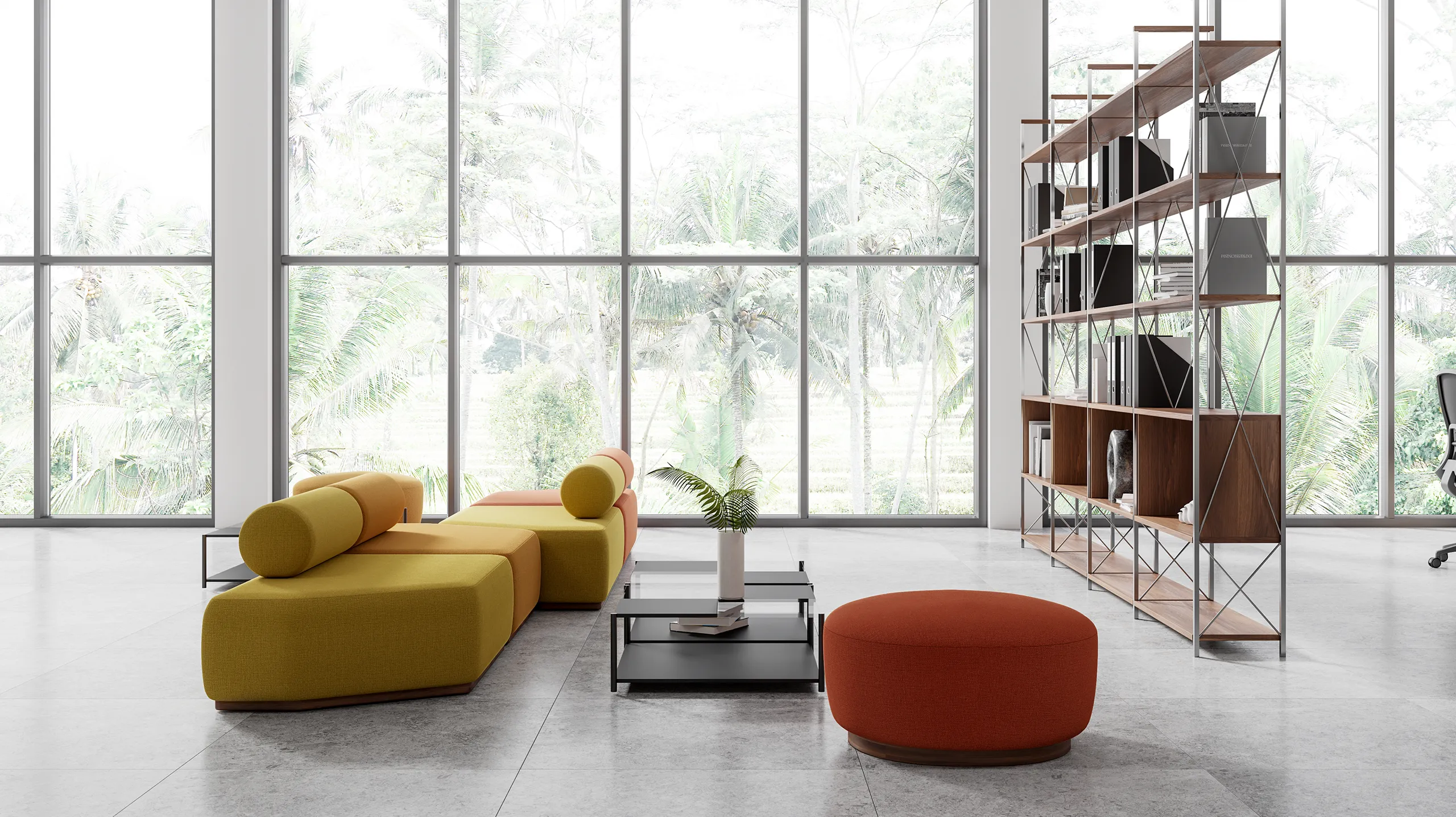
This is where modular seating or storage systems, along with mobile auxiliary furniture, come into play. If you have a sofa composed of modules, you can rearrange it in different combinations and recompose it repeatedly according to your needs. The same applies to mobile side tables: instead of being fixed, they offer the advantage of accompanying the user, and with mobile tables, the need for a central coffee table disappears. In short, any design that allows free circulation and adaptability enables the space to evolve into a structure that adjusts to its user. This approach forms the foundation of today’s flexible interior design philosophy.
LIghTNess aNd FlexIbIlITY
The second topic is lightness… This is no longer merely an aesthetic preference, but a functional necessity. The lightness and slimness of furniture directly affect the perception of spatial volume. Especially in today’s reality of small-square-meter residences, this flexibility creates an effect that expands the perception of space. Thanks to double-sided transparent bookshelves, light, air, and atmosphere can both flow through and help divide the space. Instead of using the space passively, the user can engage with it more actively and multifunctionally. Here is yet another example of the transformation in our relationship with the home — a new era that supports both physical comfort and psychological ease.
It should not be forgotten that fixed spaces produce fixed behavioral patterns. Flexible spaces, on the other hand, open up room for choice. A living room layout that allows different scenarios at different times of the day enhances both the home’s and the user’s potential. Therefore, we welcome a system that does not impose a single “correct” usage scenario — and a new era that defines comfort not only through softness, but through the capacity to adapt.
 OTheR ARTIcles