
Did you know that when we return home exhausted from work and traffic in the evening and toss our bag aside, the first place we unconsciously head toward is usually an armchair? Because as that armchair lifts the weight of the day from our shoulders, what our body seeks is an embrace that welcomes us and says, “you’re home now.” It is the silent authority of the home and of coming back to ourselves. Neither entirely public nor completely private. Yet precisely in this in-between zone stands that noble presence accompanying the most genuine moments of daily peace. And it is never just a piece of furniture. The term “furniture” is almost an insult when it comes to an armchair…
So why does the armchair hold a distinct position among the furniture at home? Let’s think: the table and sofa are shared spaces, while the bed is the center of privacy. An armchair, however, exists at the intersection of social and personal experience. Many of the moments when we work, relax, socialize, or spend time alone throughout the day take shape around it. For this reason, in modern home decoration, the armchair is not merely a seating unit but a space that defines the individual’s psychological boundaries within the home. Living room decoration planning, therefore, makes armchair selection a behavioral decision.
The RelaTIoNshIp BeTWeeN The ARMchaIR aNd PeRsoNal Space
According to spatial psychology, the surfaces individuals come into contact with most directly influence their perception of safety and comfort. The armchair is identified as the place where this contact is most intense. We don’t just sit on it; we lean back, curl up, stretch out, constantly shift from one side to the other. We perform every maneuver within a tiny area — and it accommodates them all. Technically, this diversity transforms the armchair from a passive object into a bodily interface. That is why ergonomic armchair design has become one of the most critical topics in today’s interior design approach.
The MYTh of “ONe CoRRecT SITTINg PosITIoN”
For many years, ergonomics literature revolved around the concept of the “correct sitting position.” Especially in office furniture, upright systems supported at specific angles to stabilize the spine were recommended. However, the home environment differs from office discipline… At home, the body does not remain in a single position; it needs to relax and shift direction. Sometimes it wants to get closer to the ground, sometimes to sink deeper. For this reason, within modern armchair design and living room layout planning, the notion of “one correct sitting position” has lost its validity. The armchair functions not as a system that fixes the body, but as one that allows changes in posture. Particularly with hybrid working models diversifying the function of the living room, it is no surprise that the armchair must adapt to both active and passive use.
The TechNIcal CoMpoNeNTs of CoMfoRT: PRessuRe, DepTh, aNd ANgle
When choosing an armchair, we often confuse comfort with “softness.” However, an overly soft seat does not support the body in the long term. What truly matters is the balanced distribution of pressure across the surface. Cushion density, foam quality, seat height, and depth all work together.
- Seat depth is determined by the user’s height and preferred position. A seat that is too deep may leave the lower back unsupported; one that is too shallow may prevent a sense of relaxation.
- Backrest angle establishes balance between relaxation and active use. An overly upright angle makes relaxation difficult; an excessively reclined angle may strain the spine during prolonged sitting.
- Armrest height and width support the upper body and strengthen the sense of personal space.
These proportions are based on millimetric calculations. During the design process, a small change in angle or a few centimeters’ difference in depth can completely transform the user experience. These proportions become even more critical, especially when making an armchair selection for a small living room.
The BodY Is NoT STaTIc ThRoughouT The DaY
Our body is not static. While in the morning it may prefer a more upright and focused posture, in the evening it may seek a deeper and more enveloping seat. Mood accompanies these preferences. Fatigue, stress, the need for relaxation, or the desire for social interaction alter the way we engage with the armchair. Therefore, armchair design should not be structured around a single scenario but around variability throughout the day. In modular armchair systems, modules of varying depths and movable units provide this flexibility. When users can rearrange the space, they also gain a psychological sense of control. This forms the foundation of the adaptive design approach rising within contemporary home decoration trends.
EMoTIoNal CocooNINg: ENvelopINg CoMfoRT
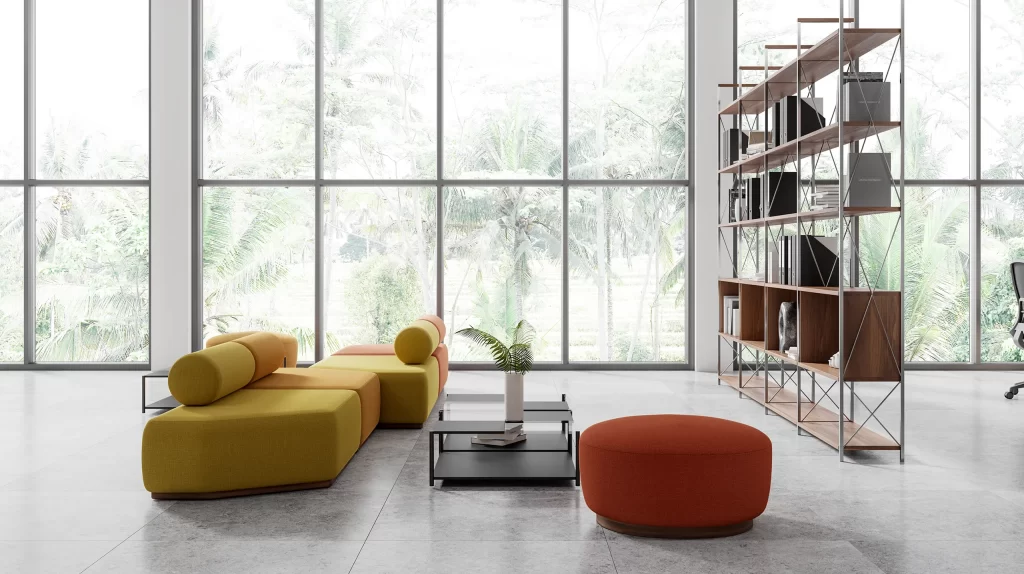
One of the prominent concepts in residential design in recent years is “emotional cocooning” — emotional enveloping. This approach advocates perceiving the home as a protective space and supporting this feeling through furniture. In this theme, defined by curved forms, soft transitions, and back structures that wrap around the body, enveloping does not mean restricting movement. On the contrary, it requires a design philosophy that embraces the body while allowing it to remain free. In this case, comfort should be considered not as a static condition but as a dynamic experience. Instead of fixing the armchair to the space, it should be viewed as a system that moves with the user — a micro-universe offering both physical and psychological flexibility through side modules, independent poufs, and recombinable components.
In short, today’s modern armchair design is synonymous with adaptability. New-generation armchairs that adjust to the variability of the body and the flow of mood create a true foundation of comfort within living room decoration — and the most personal architectural surface in the home.
 OTheR ARTIcles