There was a time when homes were considered “well-designed” the more simple, smooth, and empty they were. Glossy lacquered surfaces, glass tables, metal legs, flawless white walls… The minimalism trend shaped our lives for a long time as an aesthetic discipline. We removed excess, reduced ornamentation, simplified belongings. But after a while, something else became apparent: these homes were flawless, yet difficult to truly live in.
Because people listen not only to what their eyes see, but also to what their skin tells them.
This is precisely where the ‘textural modernism’ movement emerges — from this awareness. Within modern interior design, it is an approach that preserves clear proportions and simple compositions while elevating surfaces into the realm of sensuality. It softens the sterile rigidity of minimalism without dismantling it — an evolution rather than a rebellion. If we place minimalism in the category of an aesthetic of seeing and understanding, then ‘textural modernism’ belongs in the drawer of touching and perceiving.
WhaT Is ‘TexTuRal ModeRNIsM’?
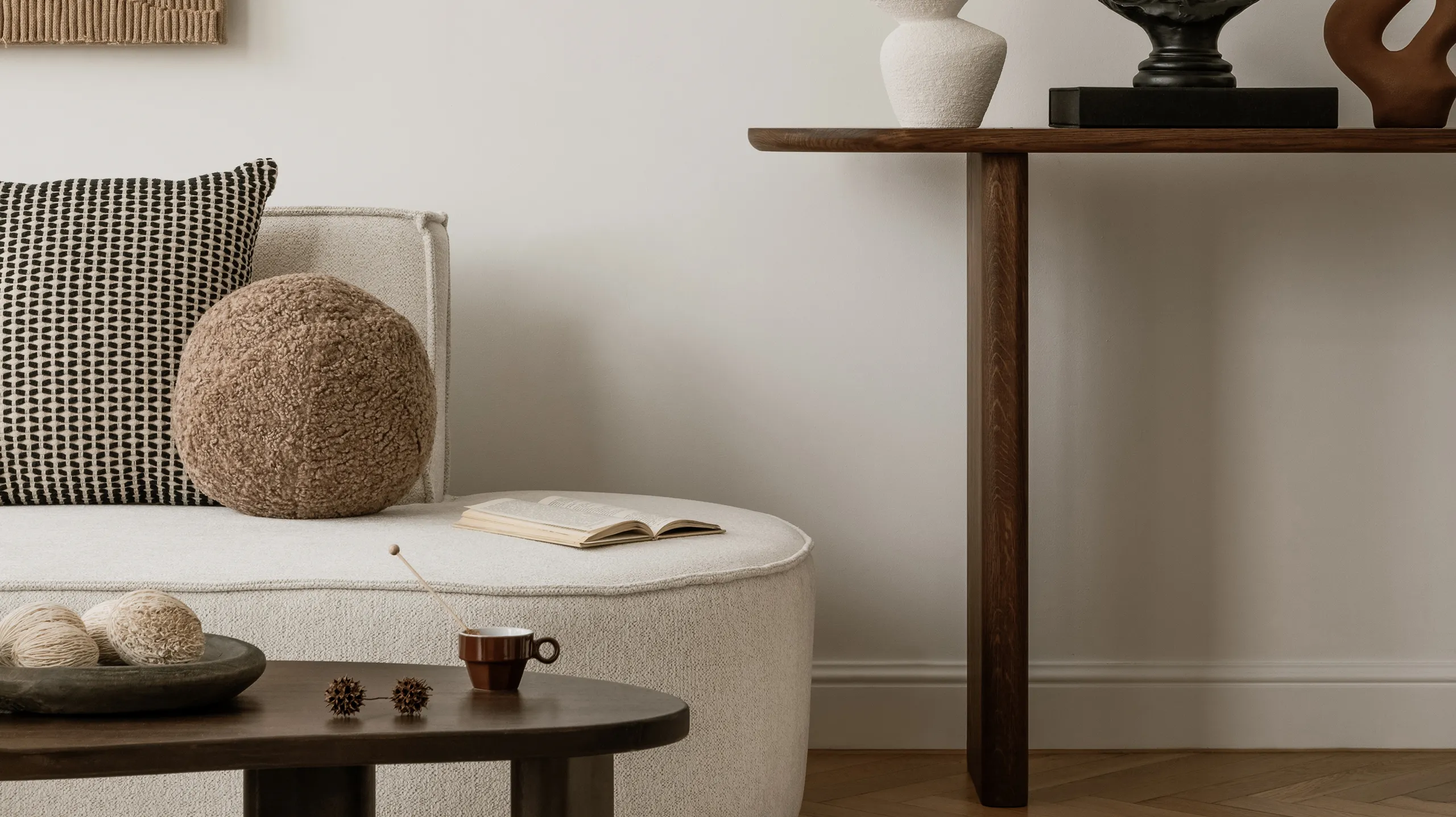
In the post-pandemic era, the home ceased to be merely an aesthetic showcase and became a psychological refuge. Since then, people have cared less about how a space looks in photographs and more about how it feels within. The light reflected by glossy surfaces, the coldness of glass, the sterile perception of perfectly lacquered cabinetry — over time, these elements keep the mind alert. Yet the home exists for relaxation… That is why surfaces began to change. Matte surfaces came to the forefront. The raw texture of natural materials became more visible. Wood is no longer fully concealed; it reveals its grain. Voluminous and textured fabrics such as bouclé, wool, and linen have returned to sofas. But note: this is not maximalism. The space remains simple, clear, and orderly. The difference is this: minimal from afar, rich up close…
The strength of ‘textural modernism’ lies precisely here: at first glance, the space appears calm — it does not create noise. The neutral color palette is indispensable: beiges, stone tones, off-whites, soft browns… Yet as you approach, you begin to notice the layers of textured surfaces. The wall is not completely flat; it even carries a subtle micro-texture. The coffee table is not entirely smooth; traces of the material remain visible on its surface. The sofa fabric is not flat, but dimensional. As light moves across these textures, the space gains depth.
What is happening here is something profoundly human: the space moves away from perfection. Because humans are not perfect, and entirely flawless surfaces subconsciously create distance. How so? Neuropsychological research shows that tactile surfaces have a calming effect on the nervous system. Wool and natural fibers are perceived as safer compared to smooth synthetic materials. For this reason, ‘textural modernism’ is not merely an aesthetic movement, but a transformation with biological resonance.
LIghTINg, ShadoWs, aNd TexTuRe
In this movement, lighting design must be emphasized. Instead of harsh white light that illuminates every corner evenly, softer lighting that reads the surface and creates shadow is preferred. Because texture becomes visible through shadow. While a matte surface absorbs light, a subtly raised texture produces shadows, giving the surface depth. The right lighting remaps the volume of texture. In short, lighting is not merely a technical detail but almost the backbone of this movement. Texture does not reveal itself under flat illumination; it emerges through the direction of light. Therefore, rather than a system that emits light from a single center and brightens every corner equally, layered lighting is more appropriate. Floor lamps, wall sconces, table lamps… Together they create small pockets of atmosphere within the space. These pockets generate both visual and emotional depth.
IMpeRfecTIoNs, SloWNess, MaTuRITY
Perhaps the most striking aspect of this approach is its proposal of slowness in an age of speed. Glossy surfaces and sharp contrasts create instant impact; they are immediately noticed. Textured surfaces, however, reveal themselves gradually. Not at first glance, but at the second and third. This extends our relationship with space over time.
‘Textural modernism’ seeks permanence rather than a “wow effect.”
Ultimately, this movement does not reject minimalism but matures it. It preserves simple forms while adding sensory layers, continues to value emptiness yet avoids coldness, allows living spaces to breathe, and most of all invites touch. Perhaps the issue is this: modern life is already sharp, fast, and smooth enough. The home should be where that sharpness is balanced. ‘Textural modernism’ establishes precisely this balance — proposing a quiet yet powerful reconciliation between an order that appeals to the eye and a warmth that speaks to the skin. In the end, we realize something important: a space is not well-designed solely because of how it looks, but because of how it makes us feel. ‘Textural modernism’ is the design language of that feeling.
 OTheR ARTIcles